

US-Iran war: Will rupee hit 100 versus US dollar soon?
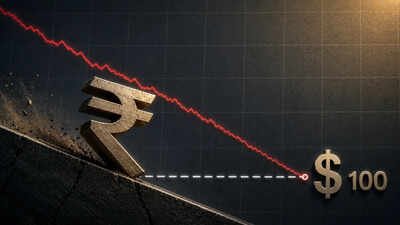
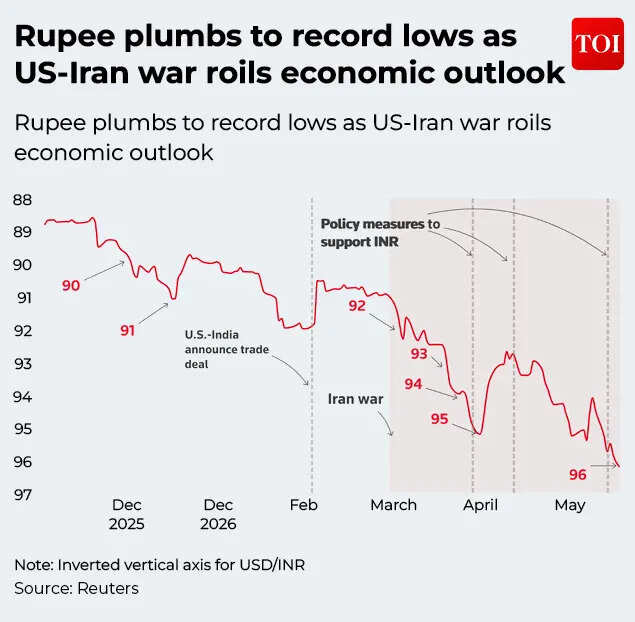
At a time when the rupee is touching all-time lows every day, the lyrics from a Bollywood movie are ringing true: “…the whole thing is that ki bhaiya, sabse bada rupaiya”. Because in the current scenario of US-Iran war and geopolitical turmoil, for India the biggest headache and nightmare is emerging in the form of rupee’s free fall versus the US dollar.Rupee depreciation is not new, what is new however is the rapid pace at which it is falling. It’s the biggest risk for India’s external sector resilience at the moment. In just over a year, the rupee has depreciated over 14%, tumbling from 85 in March 2025 to a record low of almost 97 this week. Down over 7% in 2026 alone, it has become Asia’s worst-performing currency. In fact, the recent decline has sparked concerns: will the rupee hit 100 per dollar soon? In the one-year forward market, the rupee breached the 100 level on Wednesday. A one-year outright forward spot rupee transaction tells us the expected exchange rate for a settlement one year from now.First let’s understand why a falling rupee is a matter of concern for the economy. When the rupee depreciates, it increases the cost of imports. Items like crude oil, chemicals, electronics, machinery, fertilisers become expensive. This in turn leads to inflation in the form of rising fuel, transport and food prices.
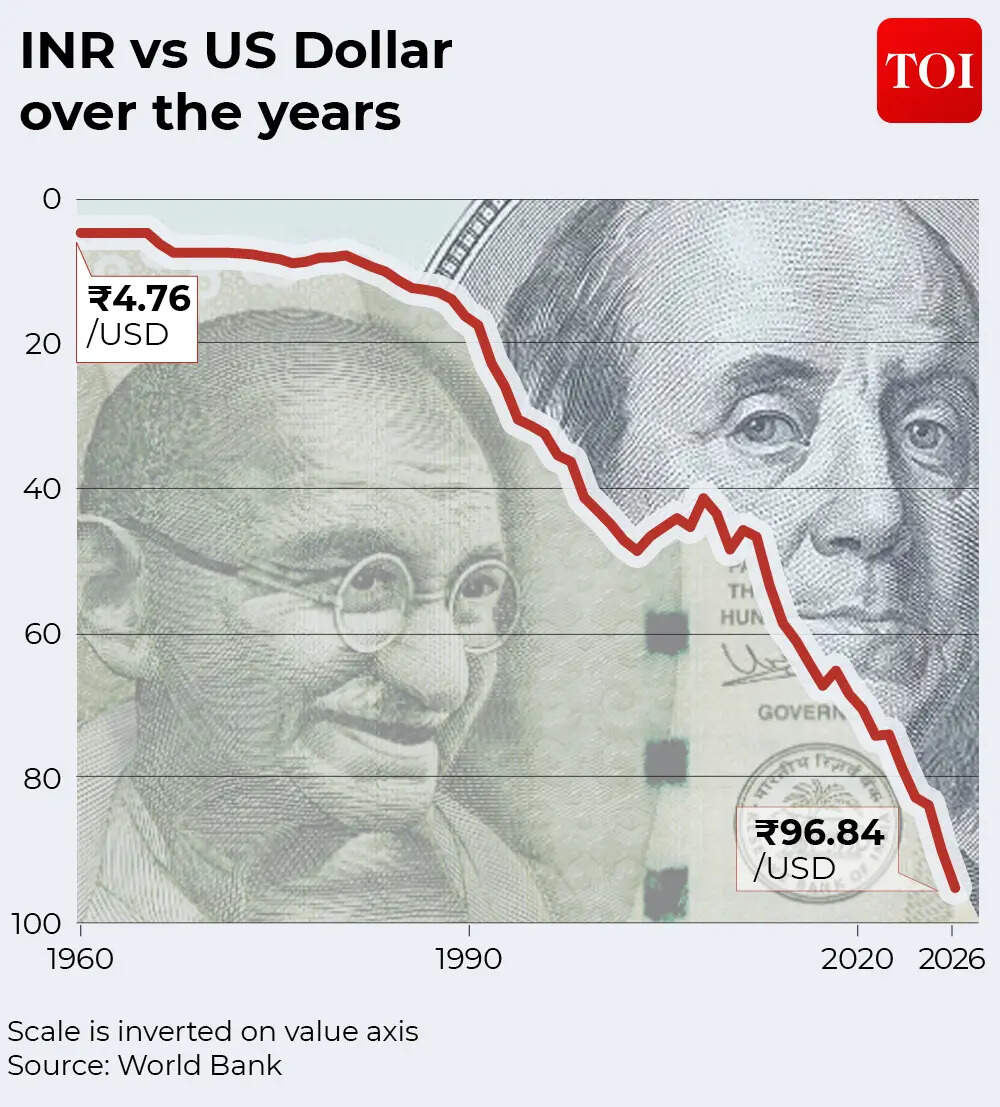
Outflow of dollars for more payments causes the foreign exchange reserves to go down, especially at times when the Reserve Bank of India (RBI) intervenes to stabilize the rupee. Also, foreign loans, overseas borrowings become more expensive for companies and individuals. All this feeds into the economic cycle, eventually slowing growth while raising inflation – a pressure situation for the government and the RBI.Which is not to say that a depreciating rupee is always bad. Within limits it works in favour of exports, making them cheaper for the importing country. Even NRIs who send money home are able to send more in terms of rupee.
Why is the rupee falling?
Vedika Narvekar, Research Analyst – Commodities & Currencies, Anand Rathi Shares and Stock Brokers points out some factors that are causing the current spree of rupee depreciation, leading to structural pressures.“What looks like a sudden currency crisis is actually the combined weight of five different global economic pressures hitting India’s external balances all at once,” she tells TOI.First, the US-Iran war pushed Brent crude past $100 forcing oil companies to flood the market to buy dollars.Second, panic has sparked a global flight to safety, foreign investors have pulled a record $21 to $23 billion out of local equities in 2026. Third, steep US tariffs on Indian exports have choked our dollar inflows. Our trade deficit hit a record $41.68 billion in late 2025 and remains widened with April trade deficit jumping to $28.38 billion vs estimated $25.97 bn in March. Finally, the interest differential. As Indian bonds yield less relative to US bonds, global capital finds India less attractive and money flows out of India. Let’s take a look at some factors in detail:Oil imports – slippery slope for rupeeThe biggest factor that is weighing on the rupee at present is crude oil prices above $100 per barrel. India imports almost 90% of its oil needs – hence a rise in crude prices has a direct impact on its import bill. To purchase the same amount of oil, more dollars are required, hence draining reserves and weakening the currency against the greenback.
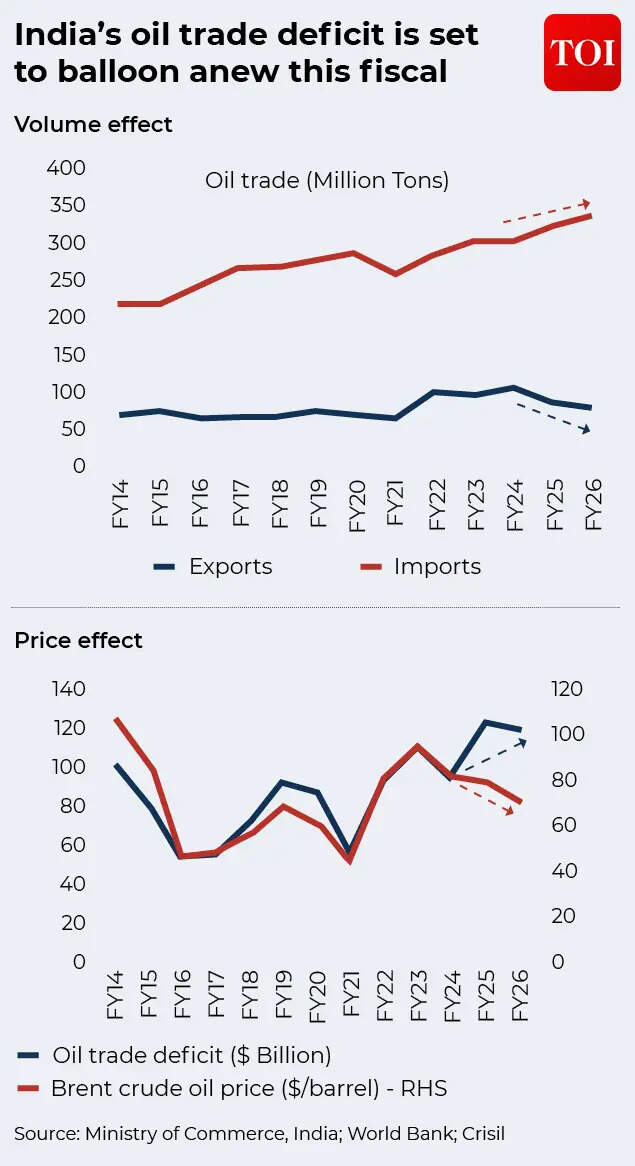
With no end in sight on the US-Iran conflict and flows through the Strait of Hormuz disrupted, the pressure on rupee caused by higher oil prices is not likely to abate anytime soon. According to PTI estimates, India spent $18.7 billion on crude oil imports in AprilForeign Portfolio Investors Turn AwayIndia, once a favourite among emerging markets for foreign investors, has suddenly fallen off the radar. 2025 saw record outflows, 2026 is proving to be no better. Globally, investors have been shifting their money into US assets which are seen to be safer in times of geopolitical tensions. US interest rate cuts have not panned out the way people expected and the ongoing global oil price rally is unlikely to trigger a rate cut anytime soon, in fact central banks globally may be forced to hike rates to keep inflation under check.Foreign portfolio outflows from Indian equities and bonds, higher dollar demand, and weaker emerging-market currencies have all contributed to the rapid fall of rupee.Estimates suggest that in 2026, foreign investors have already sold net equities worth over $23.2 billion. Last year’s net outflow figure stood at $18.9 billion.Dollar is getting strongerFundamentally, what is working against the rupee is the fact that the US dollar is getting stronger globally. Apart from gold, the US dollar acts as a safe haven asset for investors, and in times of heightened tensions, investors are seeking its safety.What a stronger dollar does is weaken emerging-market currencies across the board. But in the case of India which is so heavily dependent on oil, the fall gets exacerbated. Gold adds to woesRupee is having to pay a heavy price for India’s love for gold. Gold forms one of the topmost imported commodities for India – which is the reason why PM Narendra Modi recently appealed to Indians to avoid unnecessary purchases. The aim is to preserve the forex for more essential commodities such as oil. The government has recently increased the import duty on gold and silver in a bid to discourage imports. Import of gold and other precious metals also weighs on the current account deficit, hence weakening the currency further.Trade Deficit is wideningNow, if India is importing heavily and its dollar outflows are increasing, exports should be able to help counter this by raising the inflows. That’s not happening. According to experts, a higher trade deficit is adding to the rupee’s woes.
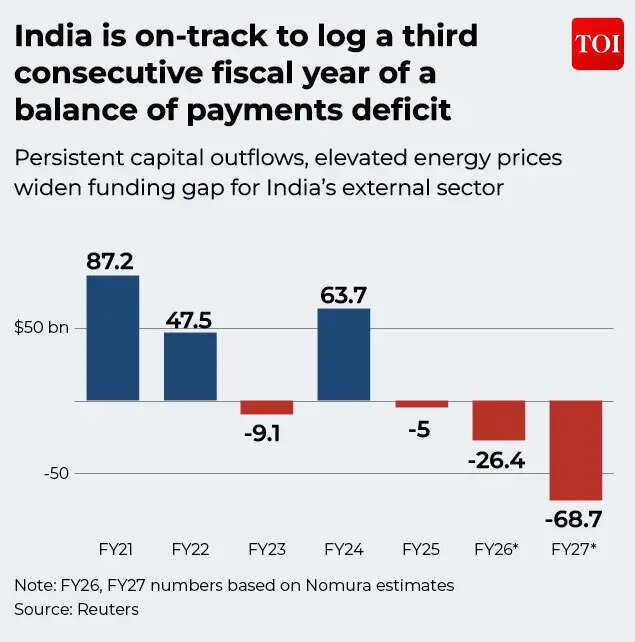
Will the rupee touch 100 anytime soon?
What looked unimaginable a few months ago, may be a reality at some point in time, though not soon, say economists and experts.“The rupee faces immense pressure and the one year forward has breached the 100 mark. This means that the market is looking at an average normal 2-3% annual depreciation that is as per trend,” says Ranen Banerjee, Partner and Leader, Economic Advisory, PwC India.He doesn’t see the rupee hitting 100 right now. “Markets expecting around annual 3% depreciation from current levels in forward markets is not unusual. However, this does not mean that the 100 mark would be breached in the immediate term. The trajectory of the exchange rate will be determined by the severity and length of disruption to the global commodity flows,” Banerjee tells TOI.Vedika Narvekar believes that the rupee’s rapid slide isn’t a reflection of domestic economic failure, but a classic case of external shocks testing a strong economy.“With the one-year forward market already breaching 100, touching this psychological milestone this year is no longer unthinkable if oil spikes again, but the rupee will eventually find its floor,” she tells TOI.According to the Anand Rathi expert, to reverse the course, we need a ceasefire in West Asia to cool oil prices back to $80, or a US-India trade deal to drop tariffs, which could spark a sharp recovery toward 89 or 90. “For now, India’s core domestic fundamentals (GDP Growth, domestic consumption etc) remain robust, but, as mentioned, external forces are playing a dominant role. In the near term, expect the rupee to trade between 95 and 98,” she says.
What can be done to stem the fall?
The Reserve Bank of India has been intervening to stem the fall – with partial success in the month of April. The situation has worsened since. RBI’s measures smoothen volatility, but what is needed at this time is a consistent inflow of capital to drive home more dollars.
Ranen Banerjee is of the view that the government has progressively taken many measures on export process simplification, liquidity and credit availability for businesses besides regulatory and behavioural nudges on consumption that drain forex for India. “It needs to continue on progressive temporary relaxation of documentation and scrutiny processes for exports,” he says. Banerjee lists some other measures that may work to strengthen the rupee:
- The government could consider bringing back more attractive yielding sovereign gold bonds and opening them up for NRI investments too.
- Tax incentives for housing to increase demand for home loans to wean investable surplus of households from gold to real estate could also be explored.
- Short-term attractive dollar deposit schemes for NRIs with government underwriting and taking a hit on fiscal for the same could also be explored.
- Incentives to importers on bilateral rupee settlement of their imports through barter mechanisms could also be explored for a short window.
- The Public Sector Enterprises should be urged to invest in coal gasification, fertiliser production and gold exploration/beneficiation of gold ores that may have become more viable now with the increase in gold prices.
- The government could also consider viability gap funding based PPP projects to set up EV charging infrastructure across the country to give a fillip to EV adoption.
Some experts expect the RBI to turn to a rate hike scenario. Till December, the central bank was cutting rates, six months later a hike in repo rate may be loading.“RBI might possibly consider a rate hike in June or even through an emergency meeting,” says Vedika Narvekar. How will that help? It does two important things: it makes Indian bonds attractive to foreign investors again, and it cools down local demand for expensive, dollar-heavy imports like electronics.Narvekar points out that the government is actively weighing measures on vegetable oil imports. “Alongside this, they are planning to tighten currency controls, forcing exporters to bring their foreign earnings home much faster and placing strict caps on how much money Indian companies can invest overseas,” she says.“Combined with the RBI’s ongoing dollar sales from our reserves and their recent $5 billion currency swap auction, policymakers are sending a very clear message to the markets that they will do whatever it takes to protect the rupee,” she adds.The rupee may not be in triple digits yet – but warning signals for a structurally weak currency are in place. The task is cut out for both the government and the RBI to keep the rupee from hitting a century, while keeping the domestic growth story intact. Economists are confident about India’s economic resilience and domestic-demand driven growth story to soften the blow.